Tuesday, 8 September 2009
Sunday, 2 August 2009
Sunday, 26 July 2009
Interesting lady: Émilie du Châtelet
Name : Émilie du Châtelet
Real name: Émilie de Breteuil
Title: Marquise du Châtelet
Date of Birth: December 17,1706
Nationality: French
Job: mathematician, writer, physicist, translator... in a word, scientist.
Main works: Dissertation sur la nature et la propagation du feu (1737), Lessons in Physics (1740) and translation into French, together with her own comments, of Newton's Principia Mathematica. In her research she introduced notions that would soo lead researchers to the concept of conservation of energy.
Links and more at Wikipedia
"The scientist that history forgot"
an article by David Bodanis at The Guardian
"The scientist that history forgot"
an article by David Bodanis at The Guardian
Saturday, 25 July 2009
Thursday, 23 July 2009
Guided tour of Verona: Juliet's house
Welcome to beautiful Verona in Italy
Where you'll find a very peculiar attraction: Juliet's house
Meet the lady in person:
This is the balcony where Juliet stood while devoted Romeo declared his love.
Let's not doubt it.
(it's also a fine example of XVth century recycling: take an old sarcophagus and stick it to the wall, there you have a nice balcony)
In the passageway leading to the courtyard one is astonished to see this:
Love is in the air, I mean in the wall
Literally thousands of love notes and messages!!
and graffitis
I guess neighbours are used to it now
And to end the visit, meet a present day charming Juliet:
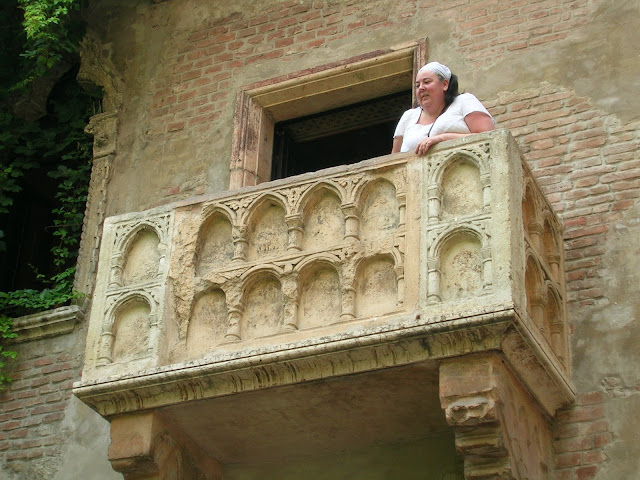
Thank you for visiting Juliet's house. I hope you enjoyed your time with us.
I hope to see you all back soon.
Sunday, 19 July 2009
Friday, 17 July 2009
Illustration loves fashion
oy
from Versace's spring-summer collection 2009
Illustrator: Julie Verhoeven
check it out at vogue.es
Sunday, 12 July 2009
Curious about...Grotesque
GROTESQUE
Definition from Britannica.com:
"In architecture and decorative art, fanciful mural or sculptural decoration involving mixed animal, human, and plant forms. The word is derived from the Italian grotteschi, referring to the grottoes in which these decorations were found c. 1500 during the excavation of Roman houses such as the Golden House of Nero. Grotesque decoration was common on 17th-century English and American case furniture.
First revived in the Renaissance by the school of Raphael in Rome, the grotesque quickly came into fashion in 16th-century Italy and became popular throughout Europe. It remained so until the 19th century, being used most frequently in fresco decoration. Although the animal heads and other motifs sometimes have heraldic or symbolic significance, grotesque ornaments were, in general, purely decorative"
All photos ©Adrian Fletcher and posted here with the author's permission, thank you Adrian!
You can visit his website paradoxplace.com , which is loaded with beautiful photographs and relevant descriptions, for a feel of a truly artistic journey around Italy.
Photos:
1.Ceiling of the Piccolimi Library in Siena Duomo
2. Ceiling of a passageway in Assisi
3. Ceiling of the Vasari Corridor of the Uffizi Gallery, Florence
4. Border in the Cathedral of Santa Maria Assunta, Spoleto.
Sunday, 5 July 2009
Memoirs of a Geisha
I finished reading Memoirs of a Geisha by Arthur Golden not long ago. I really enjoyed this paragraph in chapter 13 when Sayuri recalls a moment, early in her youth, when she stopped mourning for her losses and began looking ahead at her new life:
"I may have been no more than fourteen, but it seemed to me I'd lived two lives already. My new life was still beginning, though my old life had come to an end some time ago. Several years had passed since I'd learned the sad news about my family, and it was amazing to me how completely the landscape of my mind had changed. We all know that a winter scene, though it may be covered over one day, with even the trees dressed in shawls of snow, will be unrecognizable the following spring. Yet I had never imagined such a thing could occur within our very selves. When I first learned the news of my family, it was a though I'd been covered over by a blanket of snow. But in time the terrible coldness had melted away to reveal a landscape I'd never seen before or even imagined. I don't know if this will make sense to you, but my mind on the eve of my debut was like a garden in which the flowers have only begun to poke their faces up through the soil, so that it is still impossible to tell how things will look. I was brimming with excitement; and in this garden of my mind stood a statue, precisely in the center. It was an image of the geisha I wanted to become."
Subscribe to:
Posts (Atom)


